

History explains, but it does not answer
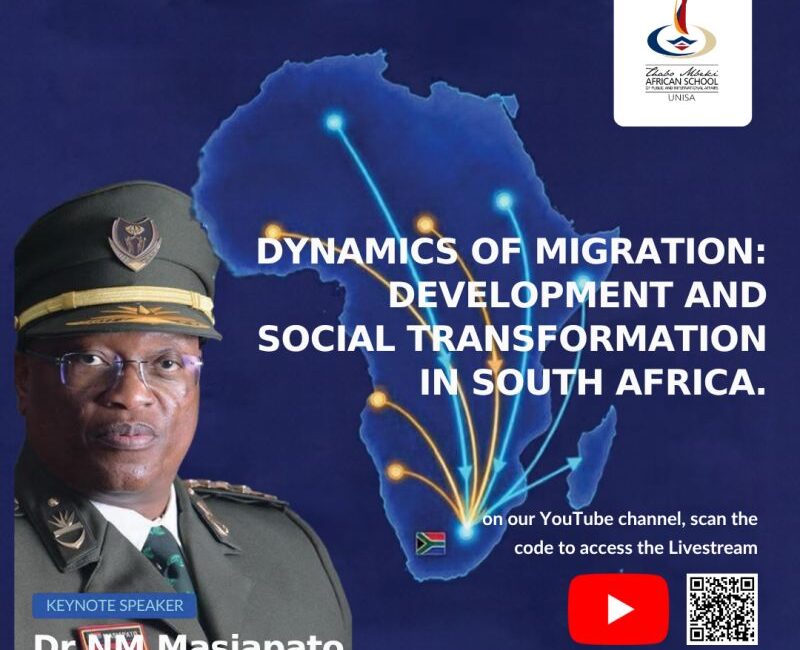
On 26 October 2026, the Thabo Mbeki African School of Public and International Affairs (TM-School) hosted its inaugural Dynamics of Migration Seminar at UNISA, under the theme “Dynamics of Migration: Development and Social Transformation in South Africa.” The room brought together the state, the academy and organised civil society. What stood out was not where they disagreed, but the question none of them could fully answer: who is listening?
Prof Edith Phaswana opened the seminar with the historical context. She reminded us that ‘South Africa was built’ by people from across the continent, and encouraged us to read the history books that record it.
The history is real. But it does not answer the questions South Africans are asking today. A citizen worried about illegal immigration in their community is not disputing the historical rhetoric and academic contribution to social cohesion. They are asking why the system is not working now. When that concern is met with a history lesson, it is heard as a dismissal. And a dismissed concern does not disappear. It looks for another way to be heard.
To her credit, Prof Phaswana did not stop at history. She turned the lens on the state itself, and the rest of the day followed where she pointed.
Who benefits from a broken system?
Prof Phaswana recalled how fraudulently issued South African passports led the United Kingdom to impose visa requirements on South Africans, at a cost borne by ordinary citizens. These, she said, “are not merely administrative figures but they also represent fundamental weakness in state capacity and institutional integrity.”
She then asked the question that framed the rest of the day: how can the state demand compliance from migrants when the institutions responsible for administering migration are themselves vulnerable to manipulation and corruption?
“But a more important question,” she continued, “is who benefits from dysfunctional migration systems?” Her answer named corrupt officials, exploitative employers, criminal networks and intermediaries. Too often, she observed, the migrant becomes the visible target of public anger, while those who exploit the system remain invisible.
Her closing illustration landed hard. Migrants who accept far lower wages than unionised South Africans do not escape exploitation; they are simply exploited alongside South Africans. The system, she argued, makes no distinction between a black South African and a black Zimbabwean.
The state’s own account: “chaos became the order of the day”
The keynote by Dr NM Masiapato, Commissioner and CEO of the Border Management Authority (BMA), gave the state’s own answer to that question. He spoke, as he made clear, as an employee of the state.
He began with conceptual clarity. Migration is the movement of people, and it “is not meant to be stopped”; it is meant to be managed. The confusion, he argued, comes from conflating migration with illegal migration.
His account of how South Africa arrived here was candid. After 1994 the military was withdrawn from the border, and around seven departments sent their own people into the border environment, each with its own procedures and systems. Five attempts at coordination failed. “When we have silos in the ecosystem,” he said, “naturally what comes up is basically what is called corruption.” For close to 28 years, “chaos became the order of the day.”
The Border Management Authority Act was signed in 2020, after discussions that began in 2005. The BMA has operated under a single command since 1 April 2023.
Dr Masiapato was equally direct about the nature of today’s problem: “We do not have a problem of refugees in South Africa. We have a problem of what we call economic migrants.” He described two weaknesses that are being exploited:
- The 90-day visa-free entry for SADC visitors is used to stay indefinitely, through repeated exits and re-entries, and passports stamped at ports by third parties.
- The asylum system carried a backlog of around 150,000 applications. Rejections, appeals and court reviews can keep applicants in the country for 15 to 20 years while they wait for a final outcome.
He cited around 2.4 million undocumented people (Stats SA, 2022), more than a million illegal crossing attempts stopped, around 240 facilitators arrested, and more than 130 officials dismissed after body-camera footage exposed them. He also cited an asylum rejection rate of around 95%.
His images from the river crossings were the most sobering of the day: smugglers ferrying women and children across rivers on inflatable mattresses, and raising the price mid-river. “These are serious practical issues,” he said, “and they involve life and death.”
“We thought we were unique”
Prof Tefu took the argument back to policy choices made after 1994. Where other countries applied established principles, he said, South Africa “thought we were unique.” He argued that South Africa did not apply the first-safe-country principle, and that it treated the national-interest exception to admission as inhumane.
He distinguished asylum seekers from refugees. He said that around 95% of applicants assessed had been found to be economic migrants rather than people fleeing persecution. His recommendation was refugee reception centres at the border, which he noted is partly reflected in the White Paper on Citizenship, Immigration and Refugee Protection. “Politicians take too long to listen to us,” he observed.
He also gave credit where it was due, acknowledging that Home Affairs has dismissed compromised officials in recent years, while warning that corruption takes two.
His sharpest point concerned language. Labels such as “xenophobic”, he argued, are applied to South Africa in ways they were not applied when Nigeria and Ghana expelled each other’s nationals. “Be careful about the terminology that you use,” he warned, “because it also creates tension in the family, black on black.”
“We have met with silence and no response”
The civil society voice in the room belonged to Dr Gordon Rolls, who works from inner-city Johannesburg and has led community dialogues on behalf of the sector. His account went to the heart of the seminar’s unspoken question.
“We have written letters, we’ve requested engagements to actually discuss these issues with Home Affairs,” he said, “but we have met with silence and no response.” Organisations that push for illegal immigration to be dealt with, he argued, are avoided rather than engaged. And when people are not engaged, they look for other ways to be heard.
He also called for precision in language. Migration, he said, is not the problem; South Africans have no issue with lawful movement. He separated immigrants, irregular entrants, visa overstayers and undocumented persons, noting that some South Africans are undocumented too. “Illegal foreigner”, he pointed out, is a term defined in the Immigration Act 13 of 2002, yet “when you call them illegal you are called xenophobic.”
He warned that the gap between what the law says and what citizens believe it permits is being filled by social media, which “is not empowering people truthfully.”
One participant put the challenge most directly: “Are we listening to the people, or are we throwing the book at the people?” Were citizens part of the laws now applied to them?
Dr Masiapato’s reply in the Q&A was frank. The BMA Act requires the Authority to engage communities, and it meets every group that approaches it. But, he explained, “we are the implementers, therefore our engagement is truly operational.” Policy belongs to the Department of Home Affairs.
The listening gap
Read together, the speakers described the same failure from different positions. The academy named the state’s weak institutional integrity. The state described almost three decades of fragmentation and corruption, and the work now under way to correct it. Civil society described letters that go unanswered.
Between them sits a gap. The BMA engages on operations, not policy. Civil society says the policy department does not respond. Communities with genuine grievances are left with no channel that answers them. That gap is where frustration turns into self-help, and self-help into vigilantism.
This is why one-sided approaches have not worked. Advocacy that overlooks illegality fuels hostility and vigilantism, because citizens see their concerns dismissed as prejudice. Enforcement alone, without regard for rights and development, erodes public trust and the rule of law, because citizens do not see a system they can believe in.
The seminar showed that the state, the academy and civil society can share a room. The next step is for them to share a conversation, in which concerns are heard before they are labelled, and history is offered as context rather than as an answer.
The question the TM-School’s inaugural seminar leaves us with is a simple one: who is listening?
GI Advisory News is offers specialised editorial work on critical geopolitical and current affairs.
Lunga Dweba is director of GI Advisory, where he focuses on geopolitical analysis and corporate intelligence.
Image: Seminar promotional poster, Thabo Mbeki African School of Public and International Affairs (TM-School), UNISA.