


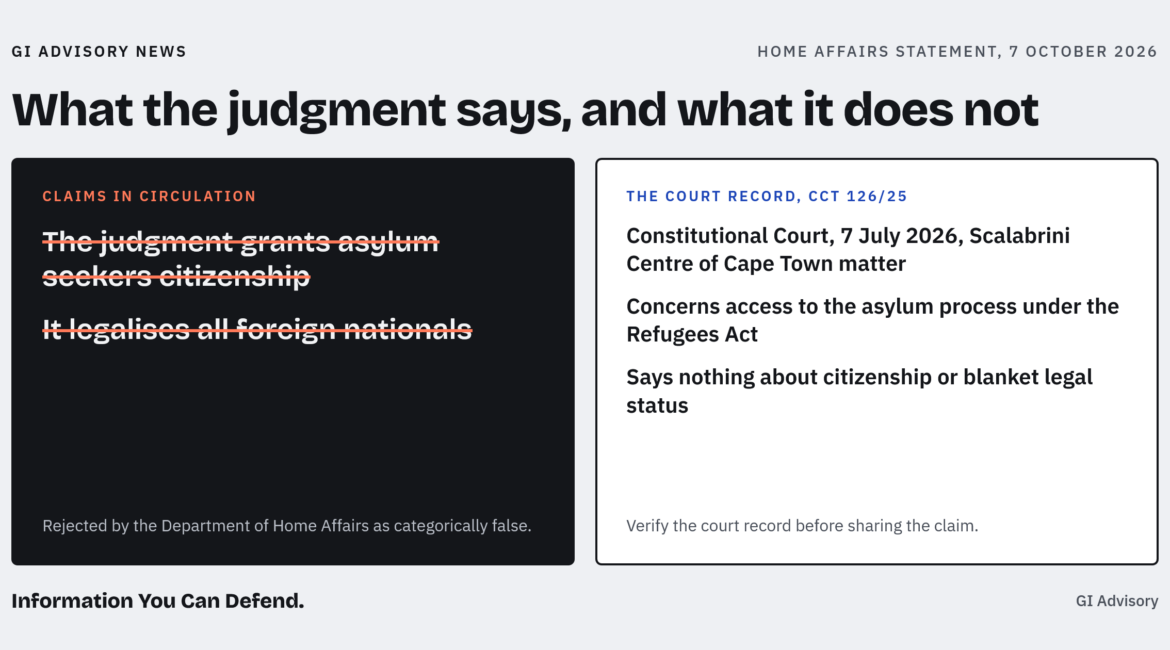
The Department of Home Affairs has announced action against what it describes as a coordinated disinformation campaign concerning the Constitutional Court’s 7 July 2026 judgment in the Scalabrini Centre of Cape Town matter.
The Department says the matter will be referred to the Independent Electoral Commission under the newly published Code of Conduct on Countering Disinformation.
Home Affairs maintains that it opposed the litigation and that the operational directive subsequently issued on asylum processing was intended solely to give effect to the Constitutional Court’s binding judgment. The Department has rejected claims that the suspension of good-cause interviews was initiated by the Minister, the Department or political parties.
It has also rejected claims that the Constitutional Court judgment grants asylum seekers citizenship or amounts to the blanket legalisation of foreign nationals.
The Constitutional Court judgment concerned the legal framework governing access to the asylum system and the consequences of failing to comply with certain procedural requirements under the Refugees Act. The Court declared specified provisions unconstitutional and invalid, subject to the orders and directions contained in its judgment.
The judgment does not, on its face, state that asylum seekers are granted South African citizenship or that foreign nationals are granted blanket legal status.
Home Affairs says the claims are false and describes the campaign as disinformation. The Constitutional Court judgment of 7 July 2026 provides the primary record of what the Court decided.
What remains clear is that a binding Constitutional Court judgment must be understood from the judgment itself rather than through political messaging, social-media commentary or assumptions about its consequences.
The position is straightforward: asylum applications must be processed consistently with the court judgment. Government must work out a lawful operational and legislative framework that still allows immigration control while respecting the constitutional protections identified by the Court.
Information You Can Defend.