

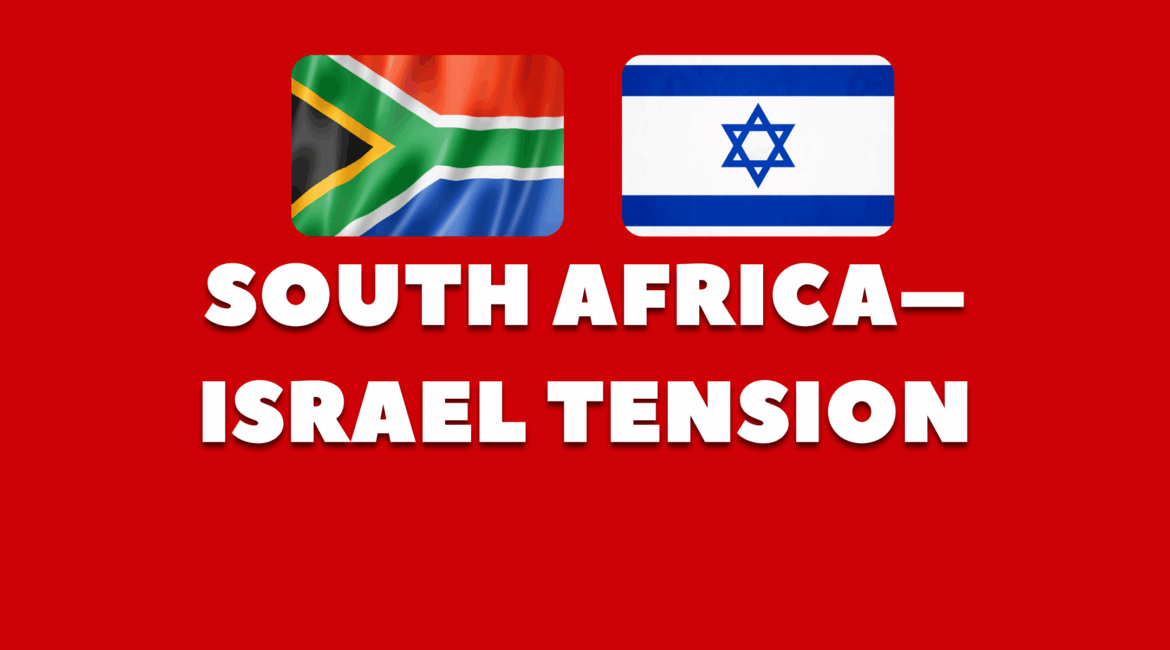
Despite pursuing a genocide case against Israel at the International Court of Justice, South Africa’s economic engagement with Israel has continued in specific sectors. In 2025, South Africa became Israel’s largest seaborne coal supplier, following Colombia’s August 2024 export ban.
According to Kpler commodity analytics, Reuters reporting (December 2025), UN COMTRADE data, and figures from the South African Revenue Service, South African coal accounted for approximately 55% of Israel’s seaborne coal imports, valued at about USD 73 million in 2024.
This coexistence of legal confrontation and continued trade provides important context for recent diplomatic developments. South Africa and Israel have since engaged in reciprocal persona non grata declarations under Article 9 of the Vienna Convention, marking a clear escalation in diplomatic strain.
What happened
The Department of International Relations and Cooperation (DIRCO) declared Israeli Chargé d’Affaires Ariel Seidman persona non grata, citing breaches of diplomatic protocol. These include public statements directed at President Cyril Ramaphosa and the failure to notify DIRCO of official visits by Israeli government officials.
Israel has responded with equivalent measures against South African diplomatic personnel. Pretoria’s position is that the conduct in question breached diplomatic norms and challenged South Africa’s sovereignty.
A longer-standing pattern
The decisions by both countries to invoke the Vienna Convention reveal deeper ideological differences between South Africa and Israel. These differences relate to positions on self-determination, international law, and regional conflicts. They are longstanding and unlikely to be resolved in the near term.
Historical context
A key turning point dates back to the 1967 Six-Day War. As Israel faced growing international isolation, it strengthened ties with apartheid-era South Africa, including cooperation in military, intelligence, and nuclear sectors. These historical alignments continue to influence political perceptions and diplomatic positioning today.
What this means for the coal mining sector
For the coal mining sector, the situation shows how geopolitical tensions can coexist with economic dependence. Diplomatic escalation does not automatically disrupt trade flows, but it increases political and regulatory risk around supply chains, export approvals, financing, insurance, and government-to-government coordination.
Mining companies, traders, and logistics providers operating in politically sensitive corridors need to account for how shifts in diplomatic relations may affect contracts, reputational exposure, and long-term market access.
Understanding this history is not academic. It informs risk assessment, stakeholder engagement, and long-term planning. GI Advisory supports clients by translating raw data and geopolitical developments into decision-relevant business intelligence.